Let's say you show a five years old kid, a hundred pictures of cats. You never explain what "whiskers" or "pointy ears" are. You just say "cat" every time, and "not cat" for everything else. After a while, the kid starts pointing at cats on their own — even ones they've never seen before, in weird lighting, from a weird angle. Nobody handed them a rulebook. They just... figured it out. That, in a nutshell, is deep learning.

Okay, but what actually is it?
Deep learning is a branch of machine learning where a computer learns patterns from huge piles of data using something called a neural network, a structure loosely (and I mean loosely) inspired by how neurons in your brain connect to each other.
Instead of a programmer writing rules like "if the image has pointy triangular shapes on top of a round shape, it's probably a cat," the network looks at thousands (or millions) of labeled examples and gradually adjusts itself until it gets good at telling cats from, say, toasters.
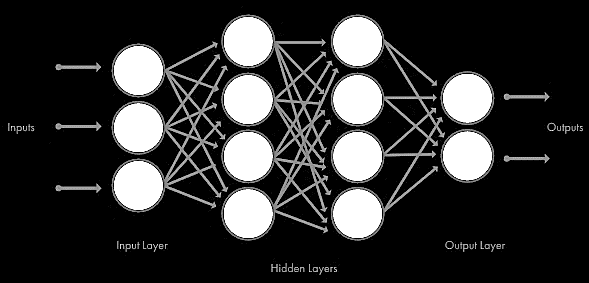
The "deep" part just means the network has many layers stacked on top of each other. Each layer picks up on something slightly more abstract than the one before it:
- The first layer might notice edges and colors.
- The next layer might notice shapes — curves, corners, textures.
- A few layers deeper, it starts recognizing eyes, ears, fur patterns.
- By the final layer, it's confidently going "yep, that's a cat."
No human sat down and coded any of that. The network built its own internal understanding just by seeing enough examples and being corrected when it got things wrong.
So how does it actually learn?
Here's the fun part. When the network makes a guess and gets it wrong, it doesn't just shrug. It runs a process called backpropagation, which is basically the network asking itself: "Okay, which of my millions of internal knobs and dials pushed me toward the wrong answer, and by how much?" Then it nudges all those knobs slightly in the right direction.
Do this over millions of examples, thousands of times, and the network slowly tunes itself into something genuinely good at the task. It's less "programming" and more "very patient trial and error at a scale no human could ever manage."
This is also why deep learning needed two things to really take off:
- Tons of data — the internet basically handed us that for free.
- Serious computing power — mainly GPUs, which happen to be great at doing the massive amounts of matrix math this all boils down to.
Without both, the idea existed in papers for decades but just wasn't practical. Once we had cheap GPUs and internet-scale datasets, deep learning went from "interesting academic idea" to "the thing powering half the apps on your phone."
Where you're already using it
You don't need to work in AI to be surrounded by deep learning. It's quietly running behind:
- Your phone unlocking when it sees your face
- Spotify or Netflix guessing what you'll like next
- Instagram automatically tagging who's in your photos
- Google Translate turning a sentence into decent Turkish or English
- Self-driving cars figuring out where the road ends and the sidewalk begins
- The last, large language models are under the hood, a very large, very deep neural network
Deep Learning vs. Machine Learning
Quick clarification, because people mix these up constantly: deep learning is a subset of machine learning, not a replacement for it.
Classic machine learning often needs a human to manually decide what "features" matter — someone has to say "hey model, pay attention to whisker length and ear shape." Deep learning skips that step. Give it raw pixels, raw audio, raw text, and it figures out on its own what's actually useful to pay attention to.
The tradeoff? Deep learning usually needs way more data and way more compute to get there. For a small, simple problem, a basic ML model might genuinely be the smarter choice. Deep learning shines when the problem is messy, high-dimensional, and has a ton of data behind it — images, speech, language, that kind of thing.
The one sentence version
If someone asks you to explain deep learning at a party (bold assumption that this comes up at parties), you can say: "Deep learning is a type of machine learning that uses neural networks with multiple layers to learn from data."
"It's a way for computers to learn directly from raw data, images, sound, text — by stacking layers of simple math operations that, together, learn to recognize incredibly complex patterns, without a human ever writing explicit rules for what to look for."
That's really it. Not magic, not a black box that thinks like a human, just a very large, very patient pattern-matching machine, built from a stack of surprisingly simple parts.
Further reading
- LeCun, Y., Bengio, Y., Hinton, G. (2015). Deep learning. Nature, 521, 436–444.
- Goodfellow, I., Bengio, Y., Courville, A. (2016). Deep Learning. MIT Press.